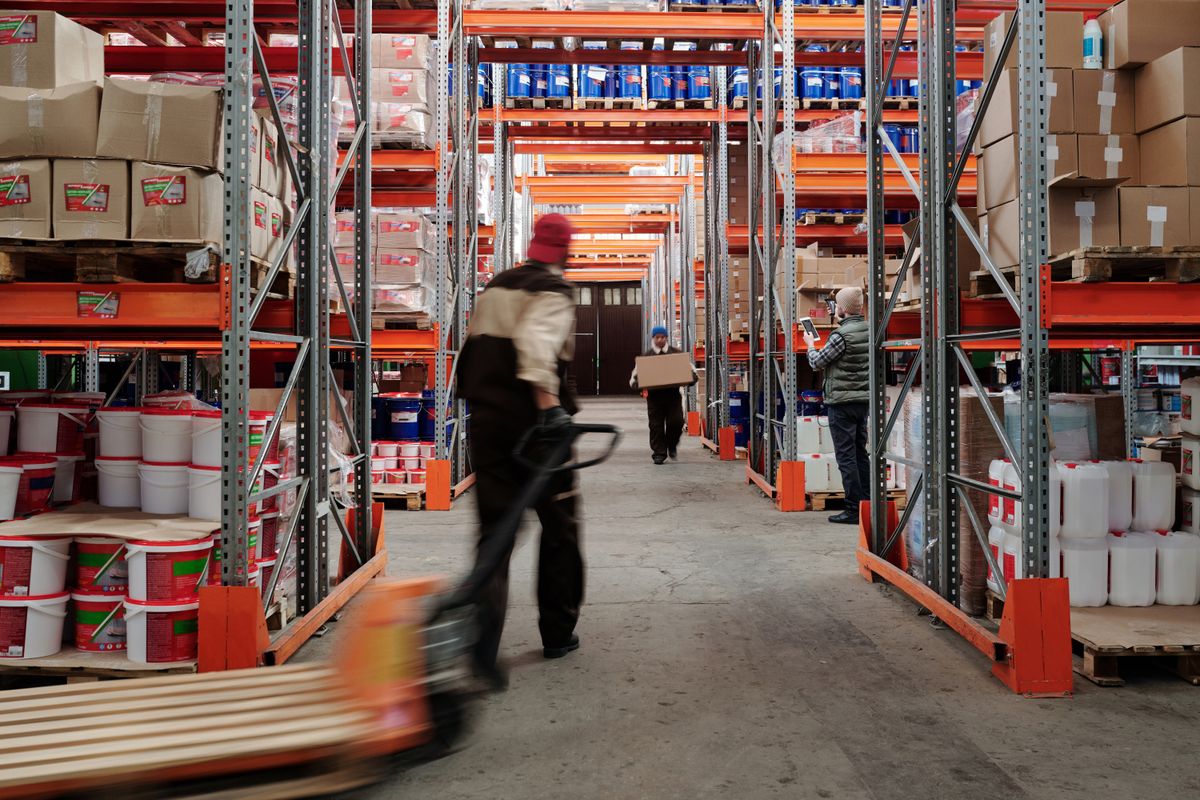
Keeping track of physical assets becomes increasingly difficult as a business grows. Manual counting, spreadsheets, and individual barcode scans can work for smaller operations, but they can become time consuming when hundreds or thousands of items are moving through warehouses, production areas, stores, or other facilities, RFID Asset Tracking Work.
RFID (Radio Frequency Identification) provides another way to identify and track physical assets using radio waves. An RFID system can use tags attached to assets, readers and antennas that capture tag information, and software that turns the captured data into useful business information.
But what exactly happens when an RFID tagged asset moves through a warehouse or tracking area?
This guide explains what RFID is, how RFID works, how RFID asset tracking works, the different types of RFID tags, and when businesses should consider RFID instead of or alongside barcode technology.
C. CONTENT OUTLINE
- What Is RFID?
- How Does RFID Work?
- 1. The RFID Tag Identifies the Asset
- 2. The RFID Reader Sends and Receives Radio Signals
- 3. The Antenna Connects the Tag and Reader
- 4. Software Turns RFID Data Into Useful Information
- What Is RFID Asset Tracking?
- How Does RFID Asset Tracking Work Step by Step?
- Step 1: Assign an RFID Tag to an Asset
- Step 2: Install or Position RFID Readers
- Step 3: Capture Tag Data
- Step 4: Connect RFID Data With Business Software
- Step 5: Monitor Asset Movement and Status
- What Are the Different Types of RFID Tags?
- Passive RFID Tags
- Active RFID Tags
- Semi-Passive RFID Tags
- What Can RFID Asset Tracking Be Used For?
- Warehouse and Inventory Tracking
- Equipment and Tool Tracking
- IT Asset Tracking
- Manufacturing and Work-in-Progress Tracking
- Retail and Distribution
- RFID vs Barcode: What Is the Difference?
- What Are the Benefits of RFID Asset Tracking?
- What Factors Affect RFID Performance?
- Is RFID Right for Every Business?
- How to Start an RFID Asset Tracking Project
- Frequently Asked Questions About RFID
- Conclusion
What Is RFID?
RFID stands for Radio Frequency Identification. It is an automatic identification technology that uses radio waves to communicate information between an RFID tag and an RFID reader.
An RFID tag typically contains a microchip and antenna. The reader sends a radio signal, and the tag responds with stored identification data. Unlike conventional barcode scanning, RFID does not generally require the reader to have a direct visual line of sight to the tag.
A basic RFID system consists of:
- RFID tags attached to products, equipment, tools, containers, or other assets
- RFID readers that communicate with the tags
- RFID antennas that transmit and receive radio signals
- Software or a host system that processes the captured information
Depending on the application, RFID readers can be handheld, fixed, mounted at doors or portals, or installed in specific locations where assets need to be detected.
How Does RFID Work?
At a basic level, RFID works by allowing a reader and tag to exchange information wirelessly.
The process can be simplified into four stages.
1. The RFID Tag Identifies the Asset
An RFID tag is attached to the asset that needs to be identified or tracked.
The tag contains an electronic chip and antenna. Depending on the tag and application, it can store identification information and other data. RFID tags are available in different shapes, sizes, materials, and configurations for different environments.
For example, a business could assign RFID tags to:
- Pallets
- Containers
- Tools
- Equipment
- IT assets
- Inventory
- Returnable transport items
- Manufacturing components
The tag becomes the electronic identity associated with the physical asset.
2. The RFID Reader Sends and Receives Radio Signals
An RFID reader communicates with RFID tags within its operating area.
With passive RFID, the reader generates an electromagnetic field that provides the energy needed for the tag to respond. The tag then sends information back to the reader using a process commonly referred to as backscatter, RFID Asset Tracking Work.
Fixed readers can be positioned at important tracking points such as:
- Warehouse entrances
- Loading docks
- Production areas
- Storage zones
- Controlled access points
- Inventory checkpoints
Handheld readers can also be used when workers need to locate or verify assets directly.
3. The Antenna Connects the Tag and Reader
The antenna plays an important role in RFID performance.
It transmits the radio signal from the reader and receives the response from the RFID tag. Antenna design, positioning, tag type, surrounding materials, and the physical environment can all influence how reliably an RFID system reads tags.
This is one reason RFID implementation should not be treated as simply buying tags and readers. The physical environment and the intended tracking process need to be considered when designing the system.
4. Software Turns RFID Data Into Useful Information
Reading a tag is only part of the process.
The captured RFID data normally needs to reach a software system where it can be processed, stored, associated with business records, and used to support operational decisions.
RFID middleware and software can filter and process reader data and integrate it with systems such as warehouse management or enterprise resource planning platforms.
The result is a connection between a physical asset and its digital record.
What Is RFID Asset Tracking?
RFID asset tracking is the use of RFID technology to automatically identify and monitor physical assets as they move through defined locations or processes.
Instead of requiring employees to manually record every movement, RFID readers can capture the identity of tagged assets when they enter or pass through a reader’s coverage area.
For example, imagine a warehouse with RFID tagged equipment.
When an asset passes through a designated RFID read point, the reader detects its tag and sends the captured information to the connected system. The software can then associate that event with the asset’s existing record.
This can help organizations answer questions such as:
- Where is a particular asset?
- When was it last detected?
- Which assets entered or left an area?
- Which equipment is available?
- Which items are still in a particular location?
- Has an asset moved through an expected process?
PointUs Tech’s RFID offering includes solutions designed for inventory, equipment, warehouse, logistics, manufacturing, and asset tracking environments. For example, the Zebra ATR7000 Overhead RFID Reader is designed for real time visibility and location tracking of inventory, assets, equipment, and other tagged items in large scale environments, RFID Asset Tracking Work.
How Does RFID Asset Tracking Work Step by Step?
A practical RFID asset tracking system generally follows a process like this.
Step 1: Assign an RFID Tag to an Asset
First, each asset that needs to be tracked receives an appropriate RFID tag.
The tag may contain a unique identifier that connects the physical asset to a record in the company’s software.
The correct tag depends on the application. A tag designed for a cardboard carton, for example, may not be the right choice for equipment with significant metal surfaces or other challenging materials.
Step 2: Install or Position RFID Readers
RFID readers are positioned where asset detection needs to occur.
A warehouse might use fixed readers around loading areas, while workers might use handheld RFID readers for inventory checks or asset searches.
For large facilities, specialized fixed RFID readers can provide coverage across defined areas. PointUs Tech’s Zebra ATR7000, for example, is designed for wide area RFID coverage and real time location applications.
Step 3: Capture Tag Data
When an RFID tag enters the reader’s operating zone, the reader communicates with the tag and captures its identification data.
One important advantage of RFID is that tags can often be detected without the direct line of sight required by conventional barcode scanning. RFID systems can also be designed to capture multiple tagged items, depending on the technology and application, RFID Asset Tracking Work.
Step 4: Connect RFID Data With Business Software
The reader sends the captured information to the appropriate software or host system.
The system can then associate the tag’s identity with information such as:
- Asset description
- Asset number
- Assigned location
- Movement history
- Inventory status
- Maintenance information
- Department or owner
The exact information depends on the business system and the tracking application.
Step 5: Monitor Asset Movement and Status
Once the RFID system is integrated into the operational workflow, businesses can use the collected data to improve asset visibility.
For example, an RFID enabled warehouse could automatically detect tagged goods moving through a receiving or dispatch area. GS1 describes warehouse use cases in which RFID read points can automatically capture RFID tagged cartons and cases as they are unloaded.
What Are the Different Types of RFID Tags?
RFID tags are not all the same. The most important distinction is how they receive power.
Passive RFID Tags
Passive RFID tags do not contain their own battery.
Instead, the RFID reader’s electromagnetic field provides the energy needed for the tag to activate and respond.
Passive tags are commonly used for applications where businesses need relatively small, cost effective tags for identification and tracking.
Common applications include:
- Inventory
- Warehousing
- Supply chain tracking
- Retail
- Asset identification
- Pallet and case tracking
Active RFID Tags
Active RFID tags contain their own power source, typically a battery.
Because they have their own power, active tags can support longer range communication and applications requiring more continuous tracking behavior.
They can be appropriate for certain real time location and large area asset tracking applications.
Semi Passive RFID Tags
Semi passive or battery assisted tags use a battery to support certain tag functions but still communicate using an RFID reader’s signal.
The right tag type depends on the required range, environment, tracking frequency, cost, data requirements, and application.
What Can RFID Asset Tracking Be Used For?
RFID asset tracking is useful wherever organizations need better visibility into physical items.
Warehouse and Inventory Tracking
RFID can help businesses automate parts of receiving, inventory verification, movement tracking, and dispatch processes.
Instead of manually recording every individual movement, RFID read points can automatically capture tagged items as they pass through defined areas.
Equipment and Tool Tracking
Organizations can tag tools, machinery, equipment, and other reusable assets.
This can help answer a basic but important operational question: where is the equipment now, and where was it last detected?
IT Asset Tracking
Businesses with large numbers of computers, mobile devices, printers, networking equipment, and other technology assets can use RFID to associate physical equipment with digital asset records.
Manufacturing and Work in Progress Tracking
RFID can be used to track components, work in progress items, tools, containers, and production assets through manufacturing environments.
The exact design depends heavily on the production environment because factors such as metal, liquids, temperature, and reader placement can affect RFID performance.
Retail and Distribution
Retailers and distributors can use RFID for inventory visibility, stock movement, receiving, and other processes where automated identification can reduce manual work.
RFID vs Barcode: What Is the Difference?
RFID and barcode technology both help businesses identify products and assets, but they work differently.
| Feature | RFID | Barcode |
| Identification method | Radio frequency | Optical scanning |
| Direct line of sight | Generally not required | Normally required |
| Multiple item reading | Can support simultaneous tag reading | Usually scanned individually |
| Tag/label | RFID tag or RFID enabled label | Printed barcode |
| Data capture | Wireless | Optical |
| Typical use | Automated tracking and visibility | Identification and point of use scanning |
| Infrastructure | Readers, antennas, tags and software | Scanners, printers, labels and software |
This does not mean RFID automatically replaces barcode technology.
For many businesses, barcode remains practical, affordable, and highly effective. RFID becomes particularly attractive when automated identification, reduced manual scanning, or greater visibility into asset movement provides enough operational value to justify the investment.
PointUs Tech also provides barcode related technology and products, allowing businesses to evaluate identification and tracking technologies based on their actual workflow rather than choosing a technology simply because it is newer.
You can explore the available catalog through the PointUs Tech Shop, including barcode scanners, label printers, receipt printers, mobile terminals, POS equipment, and other business technology products.
What Are the Benefits of RFID Asset Tracking?
A properly designed RFID asset tracking system can provide several operational advantages.
Better Asset Visibility
RFID can provide organizations with more automated visibility into where tagged assets are detected.
Less Manual Scanning
Because RFID readers can detect tags without requiring an employee to individually aim a scanner at every barcode, certain processes can become more automated.
Faster Inventory Processes
RFID can support faster inventory counting and verification when the tags, readers, software, and environment are appropriately configured.
Improved Tracking of Asset Movement
Businesses can create read points around important locations and use RFID events to monitor movement between areas.
Better Integration With Business Systems
RFID data can be connected with WMS, ERP, asset management, and other systems so that identification data becomes part of the broader operational workflow.
What Factors Affect RFID Performance?
One of the biggest mistakes businesses can make is assuming that every RFID tag will work equally well in every environment.
RFID performance can be influenced by:
- Tag design
- Reader type
- Antenna design
- Antenna positioning
- Reading distance
- Operating frequency
- Asset material
- Metal surfaces
- Liquids
- Packaging
- Facility layout
- Interference
- Software configuration
For example, RFID tags designed for general packaging may require a different design from tags intended for metal equipment.
This is why a successful RFID project starts with the business process and environment, not simply the hardware.
Is RFID Right for Every Business?
No. RFID is not automatically the best identification technology for every business.
RFID can be particularly valuable when a business needs:
- Automated asset identification
- Faster inventory processes
- Reduced manual scanning
- Tracking across defined locations
- High volume item identification
- Better visibility into asset movement
- Integration with warehouse or enterprise systems
Barcode technology may remain the better choice when operations are smaller, individual scanning is acceptable, or the application does not justify RFID infrastructure.
In some environments, the strongest solution may actually be a combination of RFID and barcode technology.
The decision should be based on the number of assets, workflow, environment, required read range, desired automation, integration requirements, and overall business case.
How to Start an RFID Asset Tracking Project
Businesses considering RFID should avoid starting with a simple question such as, “Which RFID reader should we buy?”
A better approach is to start with the operational problem.
1. Define What You Need to Track
Identify the assets, inventory, equipment, containers, or products that require visibility.
2. Map the Movement Process
Determine where the assets enter, leave, move, wait, or change status.
3. Identify the Required Read Points
Decide where RFID detection would provide meaningful information.
4. Select Appropriate Tags
Choose tags according to the asset material, environment, required durability, read performance, and application.
5. Select Readers and Antennas
Reader and antenna configuration should match the required coverage and operating environment.
6. Plan Software Integration
Determine how RFID events will connect to your WMS, ERP, inventory, asset management, or other business systems.
7. Test Before Scaling
A pilot deployment can reveal environmental and workflow issues before a full rollout.
For businesses exploring RFID hardware, Pointus Solutions can be a starting point for evaluating technology solutions based on the intended application.
If your operation also needs barcode scanning or printing alongside RFID, PointUs Tech’s Shop Barcode products provide access to relevant hardware categories such as barcode scanners and label printers.
Why RFID and Printing Technology Often Work Together
RFID tracking does not necessarily eliminate the need for printed labels.
Many operations use a combination of RFID identification and printed information. An RFID enabled label, for example, can combine a machine readable RFID component with human readable information and potentially a barcode.
This is particularly useful when employees, customers, carriers, or other systems still need visual identification.
For businesses that need identification and printing equipment, PointUs Tech also offers Printing Products through its product catalog, including label and receipt printing solutions.
The important point is that RFID and printing are not necessarily competing technologies. They can be complementary parts of a broader identification workflow.
Conclusion
RFID asset tracking uses radio frequency communication to identify and monitor tagged physical assets. A typical system combines RFID tags, readers, antennas, and software to capture asset information and connect it with business processes.
The major difference from conventional barcode scanning is that RFID can generally capture tag information without requiring direct line of sight, and RFID systems can be designed to read multiple tags in suitable applications.
However, RFID is not simply a matter of installing readers and attaching tags. The asset type, environment, tag selection, reader placement, software integration, and business workflow all affect the final result.
For organizations considering RFID, the best starting point is to define what needs to be tracked, where it moves, what information the business needs, and which parts of the process are currently manual.
From there, the right combination of RFID, barcode, printing, mobile computing, and software can be evaluated according to the actual operational requirements.
For more information about identification, tracking, barcode, and business technology solutions, visit Pointus Solutions.
G. FAQ SECTION
1. What is RFID?
RFID stands for Radio Frequency Identification. It is a technology that uses radio waves to automatically identify tagged objects through communication between RFID tags and readers.
2. How does RFID asset tracking work?
RFID asset tracking works by attaching RFID tags to assets, detecting those tags with RFID readers, and sending the captured information to software that records and processes asset activity.
3. What is an RFID tag?
An RFID tag is an electronic identification device containing a chip and antenna. Depending on the type, it may operate without a battery or use an internal power source.
4. Does RFID require line of sight?
Generally, no. RFID can identify tags without the direct visual line of sight normally required for barcode scanning, although the actual performance depends on the RFID technology, tag, reader, antenna, and environment.
5. What is the difference between active and passive RFID?
Passive RFID tags receive energy from the RFID reader and do not have their own battery. Active RFID tags contain their own power source and can support longer range or more continuous communication in suitable applications.
6. Can RFID track inventory?
Yes. RFID can be used to identify and track inventory as products move through warehouses, distribution facilities, retail environments, and other operational areas.
7. Is RFID better than barcode?
Neither technology is universally better. RFID can provide advantages for automated identification and high volume tracking, while barcode systems can be simpler and more economical for many scanning applications. The right choice depends on the workflow and business requirements.
8. Can RFID and barcode be used together?
Yes. Many businesses can use RFID and barcode technology together. RFID can provide automated identification while printed barcodes remain useful for visual identification and conventional scanning workflows.
9. What industries use RFID asset tracking?
RFID asset tracking can be used in industries and environments including warehousing, logistics, manufacturing, retail, distribution, healthcare, and IT asset management.
10. What should a business consider before implementing RFID?
Businesses should evaluate the assets being tracked, operating environment, required read range, tag type, reader placement, workflow, software integration, scalability, and expected business benefits before selecting an RFID system.