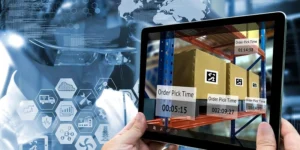
RFID Solutions: What They Are and Why Your Business Needs One
RFID technology gives businesses real-time visibility over inventory, assets, and access — without manual scanning. Here’s how an RFID solution works and where it pays off fastest.

RFID lets you read many tagged items at once without line of sight, giving instant visibility into inventory, assets, and access — ideal for warehouses, retail floors, and asset-heavy operations that have outgrown barcode scanning.
Key Takeaways- RFID tags do not need direct line-of-sight to be read, unlike barcodes.
- A reader can capture dozens of tags at once, cutting stock counts from days to minutes.
- Common uses: warehouse inventory, retail loss prevention, asset tracking, and access control.
- Barcode still wins for low-cost, single-item scanning; RFID wins for bulk, real-time visibility.
- Pointus deploys RFID hardware from Zebra, Honeywell, and Datalogic across Kuwait.
If your team still relies on handheld barcode scanners to count stock one item at a time, you already know the pain: it is slow, it needs line of sight on every single label, and it eats up hours that could be spent on actual work. RFID (Radio Frequency Identification) solves that exact problem — and it is becoming the default choice for businesses that need speed and accuracy at scale.
What Is RFID?
RFID uses small tags embedded with a chip and antenna to store data about an item — a product, an asset, a pallet, even a person’s access badge. Unlike a barcode, an RFID tag does not need to be seen to be read. A reader can pick up dozens, even hundreds, of tags at once from several metres away, through boxes, shelving, or packaging.
How an RFID Solution Works
A complete RFID solution has four moving parts working together:
- Tags — attached to products, assets, or ID cards, storing a unique identifier.
- Readers & antennas — fixed at doorways, on conveyor belts, or handheld, capturing tag data as items pass.
- Middleware — filters and organizes the raw read data into something usable.
- Software — your inventory, ERP, or asset system, where the data actually drives decisions.
Where RFID Delivers the Biggest Impact
- Warehouse & inventory management — bulk stock counts in minutes instead of days.
- Retail loss prevention — instant alerts when tagged items leave without being purchased.
- Asset tracking — know exactly where equipment is and who has it, without a manual audit.
- Access control — secure, contactless entry to buildings, floors, or restricted zones.
RFID vs Barcode: Which Do You Need?
Barcode is still the right call for low-cost, line-of-sight scanning at a checkout counter. RFID earns its cost when you need bulk reads, no line-of-sight requirement, or real-time location tracking — warehouses, large retail floors, and asset-heavy operations are where it pays for itself fastest. Many businesses run both side by side rather than choosing one over the other.
Getting Started With RFID
Pointus Solutions has deployed barcode and RFID systems across Kuwait for over a decade, as an accredited partner for Zebra, Honeywell, and Datalogic. We assess your workflow first, then recommend the right mix of hardware and software — no guesswork, no over-selling.