
How Does RFID Asset Tracking Actually Work? A Step-by-Step Guide for Warehouses
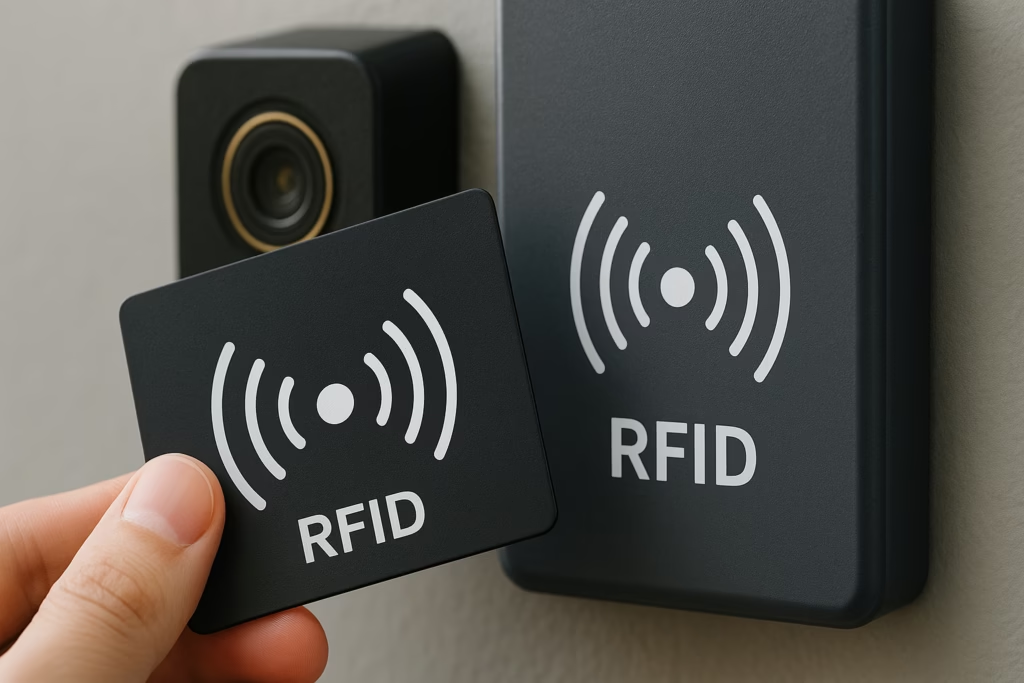
Ask most warehouse managers how RFID tracking works and you’ll get a vague answer: “the tags talk to a reader.” That’s technically true, but it skips the part that actually matters for a rollout — what happens between an item entering the building and its status updating on a screen, and where things typically go wrong along the way.
RFID isn’t a single device. It’s a chain: a tag, a reader, an antenna, and software, each doing a specific job. If any one link is mismatched to your environment — the wrong tag on a metal shelf, a reader placed where it can’t see the read zone — the whole system underperforms, no matter how good the individual components are.
This guide walks through exactly how RFID asset tracking works, step by step, and what that means practically for a warehouse floor.
Planning an RFID rollout for your warehouse? Tell us your facility size and asset types and we’ll help you map the right tags, readers, and software.
The Four Components of Every RFID System
Before the step-by-step process, it helps to name the parts. Every RFID asset tracking setup — regardless of warehouse size — is built from the same four components:
- RFID tag — a small chip and antenna attached to the asset, carrying a unique identifier
- RFID reader — the device that powers and communicates with tags in range
- Antenna — extends and shapes the reader’s signal to cover a doorway, dock, or shelf
- Software / database — receives each read event and turns it into a location and status update
Unlike barcode scanning, RFID doesn’t need a direct line of sight between reader and tag, and a single reader can capture many tags at once rather than one at a time. That’s the core mechanical difference that makes RFID faster for bulk counts and continuous tracking — and it’s also why understanding each step of the process matters more than with a barcode gun.
How RFID Asset Tracking Works, Step by Step
The Asset Is Tagged
An RFID tag is attached to the asset, pallet, or item. The tag contains a microchip storing a unique ID and a small antenna. Tags come in different formats — adhesive labels for cartons, hard tags for reusable containers, or rugged tags rated for metal surfaces or harsh environments — and the right format depends on what’s being tracked and where it sits in the warehouse.
The Tag Enters a Reader’s Field
As the tagged asset moves — through a dock door, onto a shelf, past a fixed checkpoint, or within range of a handheld reader — it enters the electromagnetic field generated by an RFID antenna connected to a reader.
The Tag Responds
Most warehouse RFID uses passive UHF tags, which have no battery. The reader’s signal itself provides the energy the tag needs to respond, reflecting back its stored ID. This is why passive tags are cheap enough to put on individual cartons or pallets at scale.
The Reader Captures the Signal
The antenna picks up the tag’s response and passes it to the reader, which decodes the unique ID. A single reader can capture many tags simultaneously — a full pallet, or a shelf of tagged items — in one pass, without needing each item aligned to a scanner the way a barcode does.
The Read Event Is Sent to Software
The reader forwards each captured ID, along with the reader/location and a timestamp, to the tracking or warehouse management software. This is the point where a raw radio signal becomes a business record: “Asset X was at Dock Door 3 at 14:32.”
The Asset Record Updates
The software matches the tag ID to the asset’s existing record and updates its location, status, or movement history. Depending on the system, this can trigger further actions — updating stock counts, closing a pick task, or flagging an asset that appeared somewhere it shouldn’t have.

Fixed Readers vs Handheld Readers in a Warehouse
Warehouses typically combine two reading approaches, and the choice affects how the six steps above play out in practice.
| Factor | Fixed Readers | Handheld Readers |
|---|---|---|
| Typical placement | Dock doors, gates, conveyor points, shelving | Carried by staff during cycle counts or audits |
| Best for | Continuous, automatic checkpoints | On-demand counts, spot checks, mobile picking |
| Coverage | Fixed read zone (e.g. a doorway) | Wherever the operator walks |
| Labour involved | None — passive capture as goods move through | Requires an operator to scan the area |
| Common use case | Receiving/shipping verification, security checkpoints | Full-facility stocktakes, locating a specific asset |
Most warehouse deployments use both: fixed readers at high-traffic chokepoints like receiving docks, and handheld readers for periodic full counts or investigating a discrepancy the fixed system flagged.
Tag Types and Frequency Bands, Explained Simply
Not all RFID is the same underlying technology. Three factors determine how a tag behaves, and getting them wrong is one of the most common reasons a rollout underperforms.
Passive vs Active vs Semi-Passive Tags
- Passive tags — no battery; powered by the reader’s signal. Cheapest option, shorter read range, most common for cartons, pallets, and general inventory.
- Active tags — have their own battery and broadcast continuously. Longer range, higher cost, used for high-value or moving assets like forklifts or containers.
- Semi-passive tags — battery-powered chip but rely on the reader’s signal to transmit, balancing cost and range.
Frequency Bands
- LF (low frequency) — short range, reliable near metal and liquids, common in access control and animal tracking
- HF (high frequency) — moderate range, used for item-level tracking and access cards
- UHF (ultra-high frequency) — longest range and fastest read rates, the standard choice for warehouse and pallet-level tracking
For most warehouse asset tracking, passive UHF is the default starting point because it balances low per-tag cost with read ranges of several metres — enough to cover a dock door or a shelving aisle.
Not sure which tag type fits your assets? Send us your material types (metal, liquid, cardboard) and we’ll recommend the right tag and frequency combination.
Why This Process Matters for Warehouse Operations
Understanding the mechanics isn’t academic — each step maps directly to an operational outcome:
- Receiving — a fixed reader at the inbound dock captures every tagged pallet automatically, verifying what arrived against the purchase order without manual scanning
- Put-away and location tracking — as assets move to storage, reads at shelving zones update their location in real time
- Cycle counts — a handheld reader walked down an aisle captures dozens of tags in seconds, replacing manual counting
- Shipping verification — an outbound dock reader confirms the correct items left, reducing fulfilment errors
- Loss prevention — a tagged asset read at an unexpected checkpoint, or not read where it should be, flags a discrepancy for investigation
This is the same logic behind warehouse management software generally: inventory optimization, stock tracking, order fulfilment, and warehouse operations from receiving to shipping all depend on knowing, accurately and continuously, where every asset is.
Common Mistakes in Warehouse RFID Deployments
Using the Wrong Tag for the Material
Standard tags perform poorly on metal shelving or near liquids, which absorb or reflect radio signals. Metal-mount or liquid-rated tags exist specifically for this reason — matching tag to surface is one of the first things to check before rollout.
Placing Readers Without a Site Survey
A reader mounted at the wrong height or angle at a dock door can miss tags on the far side of a pallet. Read zones need to be mapped to the actual traffic pattern, not assumed from a floor plan.
Treating Software as an Afterthought
Tags and readers only produce raw read events. Without software to translate those events into asset records, updates, and reports, the hardware investment doesn’t turn into usable operational data.
Skipping a Pilot
Read rates, interference, and tag durability vary by facility. Testing on one zone or one asset category before a full rollout catches problems while they’re cheap to fix.
Choosing an RFID & AIDC Partner in Kuwait
Getting RFID right in a warehouse means matching tags, readers, and software to the actual facility — not buying components off a spec sheet in isolation.
Pointus Auto ID Solutions provides Advanced Automatic Identification and Data Capture (AIDC) technologies, including barcode systems, RFID tracking, and smart labeling, aimed at real-time data visibility, alongside Supply Chain & Warehouse Management (WMS) software covering inventory optimization, stock tracking, order fulfillment, and warehouse operations from receiving to shipping.
Pointus is an authorized partner for manufacturers relevant to RFID and warehouse identification, including Zebra, Honeywell, Datalogic, HID Global, and Impinj, and brings more than 10 years of experience across 9 industries with 20+ brand partnerships.
For manufacturing environments specifically, barcode and RFID systems are used to track materials and output on the production floor, while transportation and logistics operations use RFID for fleet asset tracking, driver ID, and warehouse-to-vehicle inventory visibility.
Pointus Auto ID Solutions is based at Zainah Tower, Office B-15, Tunisia Street (Opp. Xcite), Hawally, Kuwait.

Ready to see RFID asset tracking mapped to your warehouse? Reach out with your facility size and asset types for a tailored recommendation.
A Simple Checklist Before You Deploy RFID
Before rolling out RFID asset tracking in your warehouse, confirm these points:
- What assets or inventory categories need tracking?
- What materials are involved — metal, liquid, cardboard?
- Do you need fixed readers, handheld readers, or both?
- Where are your key checkpoints — receiving, shipping, storage zones?
- What read range do you actually need at each checkpoint?
- Does your current WMS or ERP accept RFID read data, or do you need new software?
- Have you piloted the setup in one zone before a full rollout?
- Who owns ongoing tag application and read-rate monitoring?
Answering these before purchasing hardware significantly reduces the risk of a system that reads unreliably or produces data no one actually uses.
Conclusion
RFID asset tracking isn’t magic — it’s a defined chain of tag, reader, antenna, and software, each step producing a small piece of data that adds up to real-time visibility across a warehouse.
Understanding that chain matters because most deployment problems trace back to one weak link: the wrong tag for the material, a reader placed without a proper site survey, or software that isn’t set up to act on the data being captured.
For warehouses in Kuwait planning an RFID rollout, Pointus Auto ID Solutions provides AIDC and RFID hardware alongside warehouse management software, backed by authorized partnerships with manufacturers including Zebra, Honeywell, Datalogic, HID Global, and Impinj.
Ready to Bring RFID Visibility to Your Warehouse?
Talk to Pointus Auto ID Solutions about RFID tags, readers, and warehouse management software for your facility.
RFID Asset Tracking, Answered
An RFID tag attached to the asset, an antenna, a reader that captures the tag’s signal, and software that turns each read event into a location or status update.
No. RFID uses radio waves rather than optical scanning, so tags can be read without a direct line of sight, and a single reader can capture multiple tags at once.
Passive tags have no battery and draw power from the reader’s signal, making them cheaper with shorter range. Active tags have their own battery and broadcast continuously, giving longer range at higher cost.
Passive UHF (ultra-high frequency) is the typical default for warehouse and pallet-level tracking, offering the longest range and fastest read rates among common RFID frequency bands at a manageable per-tag cost.
Most warehouses use both — fixed readers at chokepoints such as dock doors for automatic, continuous capture, and handheld readers for periodic full-facility counts or investigating a specific asset.
Metal and liquid can absorb or reflect radio signals, degrading standard tag performance. Metal-mount and liquid-rated tags are designed specifically to compensate for this and should be used on those surfaces.
Yes. RFID read events are typically fed into warehouse management or inventory software, which is what turns raw tag reads into stock counts, location updates, and order fulfilment records.
Warehousing, manufacturing, retail, and transportation are common users — for example, manufacturing uses barcode and RFID systems to track materials and output on the production floor, while transportation uses RFID for fleet asset tracking and warehouse-to-vehicle inventory visibility.
Yes. Read rates, interference, and tag durability vary by facility, so testing on one zone or asset category first catches placement and tag-selection issues while they’re inexpensive to fix.
Pointus Auto ID Solutions provides AIDC technologies including barcode systems, RFID tracking, and smart labeling, alongside warehouse management software, and is an authorized partner for brands including Zebra, Honeywell, Datalogic, HID Global, and Impinj in Kuwait.